

Reference
The origin of swords can be traced back to the era of Emperor Huangdi in Xuanyuan. According to the “Annals of the Yellow Emperor”, “The emperor took copper from Shoushan to forge a sword and inscribed it with ancient astronomical characters; There is also a saying that goes, ‘In the past, gold was produced from the mountains of Ge Tian Lu, and Chiyou made it as a sword armor.’. This record indicates that swords existed during the time of Huangdi and Chiyou. The Yellow Emperor built a temple in 2704 BC, with the country name Xiong Shi. At that time, it was the beginning of the Bronze Age, but it can be inferred that the birth of swords was extremely ancient and had a long history. Therefore, later generations called it the “ancestor of short soldiers”, which is well deserved.
ancient times
The origin of swords can be traced back to the era of Emperor Huangdi in Xuanyuan. According to the “Annals of the Yellow Emperor”, “The emperor took copper from Shoushan to forge a sword and inscribed it with ancient astronomical characters; There is also a saying that goes, ‘In the past, gold was produced from the mountains of Ge Tian Lu, and Chiyou made it as a sword armor.’. This record indicates that swords existed during the time of Huangdi and Chiyou. The Yellow Emperor built a temple in 2704 BC, with the country name Xiong Shi. At that time, it was the beginning of the Bronze Age, but it can be inferred that the birth of swords was extremely ancient and had a long history. Therefore, later generations called it the “ancestor of short soldiers”, which is well deserved.

The design and manufacturing of weapons in ancient times were still in their early stages. As stated in the “Huainanzi · Si Lun”, “Ancient weapons were nothing more than bows and swords, no spears to strike, and no spears to stab.” In order to facilitate jumping and melee combat in mountainous forests, people generally used short weapons at that time. Sword is a type of short weapon, derived from spear shaped spikes and short daggers, originating before the Yin and Shang dynasties. It is extremely short in shape, with only a short flat stem and no tube. The ancient people used this sword to stab their waist, which is lightweight and easy to use. It can be used freely for both direct and side attacks, and is essential for resisting bandits and wild beasts. By the Zhou Dynasty, especially during the Spring and Autumn and Warring States periods, swords with simple structures and easy manufacturing had become the main short weapons and a must-have accessory for all social classes. Even Feng Xuan and Han Xin from the early Han Dynasty, despite being so poor that they had no food, still carried them with them. Famous ones include Gan Jiang, Mo Xie, Long Quan, Tai A, Chun Jun, Zhan Lu, Yu Chang, Ju Que, etc. The Longquan sword from the Spring and Autumn period still has one hidden in the Forbidden City, which is still very sharp today, proving that China has a long history in the manufacturing and use of swords.
During the Shang Dynasty
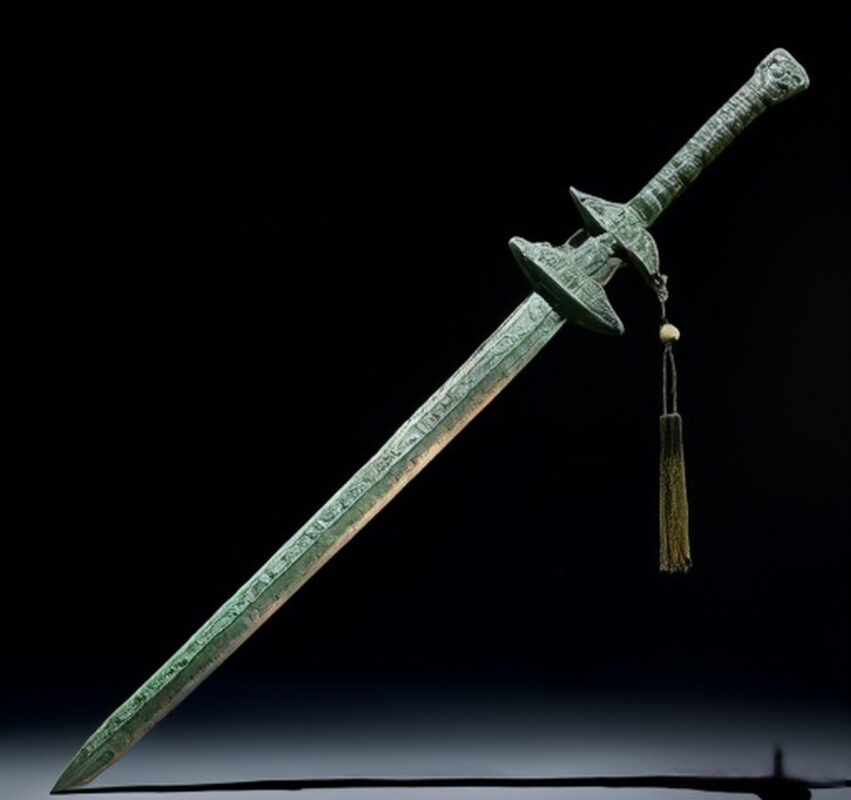
Early bronze swords were roughly formed around the Shang Dynasty. Initially, they were only about ten centimeters long, with a straight spine and double-edged edges. The sword body was flat and wide, and the handle was tied with wooden pieces without a blade. Later, a fixed shape was developed, mainly consisting of two parts: the sword body and the sword stem, each with a name. The front end of the sword body is called “Feng”, the raised center line of the sword body is called “Ji”, the sloping sides of the ridge are called “Cong”, the blade from the outside is called “E”, and the combination of the ridge and the two Congs is called “La”. The sword handle is called a ‘stem’. There are mainly two types of stems: flat and round. There is a “grid” with a handguard between the stem and the body, also known as a “guard”. The end of the stem often has a circular “head” or “stem”. Some have circular “hoops” on their stems. The stem is often wrapped with a rope, which is called “gu”, and the spiral ring at the end of the sword hilt is called “duo”. The scabbard is also known as the “chamber”. A short sword is also known as a dagger. The head and frame of a refined bronze sword are often made of jade, and this type of sword is generally referred to as a “jade tool sword”. In the next millennium, the shape of this sword will gradually mature and become active on the battlefield as a basic weapon for infantry.

Zheng E provided a detailed explanation on swords, saying that people have different shapes, sizes, and lengths. Choosing different swords is not for aesthetic purposes, but to make them suitable for each use. Therefore, it is divided into three levels of sword making, suitable for third level swordsmen, and whoever uses what sword is at their own discretion. The hilt of the sword is five inches long. If the hilt of the sword is five times that of the sword, then it should be three feet long and weigh nine clangs, which is three catties and twelve taels. It is extremely long and heavy, so it is called Shangzhi. Only tall and powerful swordsmen can wear it, so it is called the Shangshi system. The sword body is four times the size of the hilt, so the length of the sword is two feet and five inches, and it weighs seven clangs, which is two pounds and fourteen taels. The length, weight, and lightness of the sword are selected from the middle, which is called the middle system. Suitable for people of ordinary physique and strength, it is called the sergeant system. If the sword body is only three times the length of the hilt, then it is only two feet long, and the weight is only five clangs, then it weighs only two pounds, one or two or three cents. It is light and short, known as the lower system, and is suitable for short and weak people.
The above-mentioned sword techniques were mostly used in ancient times and have undergone frequent changes throughout history, with the most significant changes occurring from the Qin Dynasty to the Song Dynasty. Zheng Eyun said, “If we compare the swords of the Qin and Han dynasties with those of the Song dynasty, the long swords of the Song dynasty are 21 inches and 3 fen, while the long swords of the Han dynasty are only 17 inches and 9 fen. The short swords of the Song dynasty are 15 inches and 2 fen, while the short swords of the Han dynasty are only 10 inches and 5 fen. Therefore, the swords of the Song dynasty are longer and of better quality than those of the Han dynasty.
The purpose of a sword is not only for killing, but also as a decoration for literati. However, it is mainly used for self-defense and resisting enemies. If the sword is too long, it is inconvenient to use. If the sword is too short, it is difficult to reach far. If the sword is too short, it is light and lacks striking power, and if the sword is too heavy, it swings slowly. Both are not suitable for practical use. In addition, there is a saying in ancient books: ‘The founder of the Han dynasty won the world with a three foot sword.’ Therefore, it can be seen that the claim that the sword length of the Han dynasty was less than two feet should be incorrect. If we take into account the history of swordsmanship, the length of ancient swords varies from one foot three inches to over four feet, and their weight is two to three pounds.
eastern zhou period
During the Eastern Zhou Dynasty, the Western continent was still in a barbaric period, but the copper smelting industry in Middle earth was already very developed. Most craftsmen cast swords from copper, creating a large number of high-quality swords, and sword making techniques gradually improved. According to the records in the “Kao Gong Ji”, craftsmen during the Warring States period accumulated sufficient experience and were able to fully master the technology of smelting bronze. Depending on the purpose of the equipment, the proportion of copper, lead, and tin in the alloy also varied. This smelting technology has been leading Western countries for nearly a thousand years.
the Spring and Autumn Period
During the Spring and Autumn Period, the two countries of Wu and Yue, who were enemies with each other, were both renowned for their exquisite sword casting skills. Their exquisite craftsmanship and exquisite craftsmanship were unparalleled in the world, especially the surface treatment of the sword body, which not only had mysterious and gorgeous patterns, but still shone brightly and sharp like new 2500 years later today. This treatment technique is still a mystery to this day.
In 1994, the excavation of the second pit of the Terra Cotta Warriors was officially started. Archaeologists found that a bronze sword was bent by a 150 kg pottery figurine. The degree of bending was more than 45 degrees. When people removed the pottery figurine, a surprising miracle occurred: the narrow and thin bronze sword bounced straight in a flash and naturally recovered. The “shape memory alloy” that contemporary metallurgists dream of appeared in ancient tombs over 2000 years ago! Why hasn’t this ancient sword rusted after being buried underground for over two thousand years? Why is it still shining brightly and incredibly sharp? Through further research, it was found that the reason why the “Yue King Goujian Sword” has remained rust free for thousands of years is due to a layer of chromium containing metal coating on the sword body. Chromium is an extremely corrosion-resistant rare metal that is very difficult to extract, but the level of sword casting technology at this time remains a mystery. Among them, a batch of bronze swords were also discovered. The internal structure of these bronze swords is dense, the sword body is bright and smooth, the blade is finely polished, and the texture is not interlaced. They have been sleeping under the loess for more than 2000 years, and when unearthed, they are as bright as new and extremely sharp. After testing, researchers found that the surface of the sword had a layer of 10 microns thick chromium salt compound. This discovery immediately caused a sensation in the world, as this chromium salt oxidation treatment method was only an advanced technology that appeared in modern times. Germany invented and applied for patents in 1937 and the United States in 1950.


The late Spring and Autumn period to the Warring States period can be said to be the most developed period for copper swords. Except for a few regions where swords reflect regional or ethnic styles, their shapes generally began to take shape. In the late Spring and Autumn period, the vast majority of copper swords had a sword head and commonly had a sword frame, but there were still relatively few with sword hoops. The length is generally above 40-50 centimeters. The famous Yue King Goujian Sword, Wu King Fuchai Sword, Wu King Guangjian, and so on, are all important works of this period. These swords are exquisitely crafted, showcasing excellent craftsmanship. The bronze swords of the Eastern Zhou Dynasty are of the highest quality from the states of Wu and Yue. The “Book of Rites and Crafts” records: “The gold and tin of Wu and Yue are the most beautiful materials. The Yue King Goujian sword unearthed from the ancient tomb in Jiangling, Hubei Province, has a total length of 55.7 centimeters and is decorated with diamond patterns. The sword frame is inlaid with blue glass patterns on both sides.
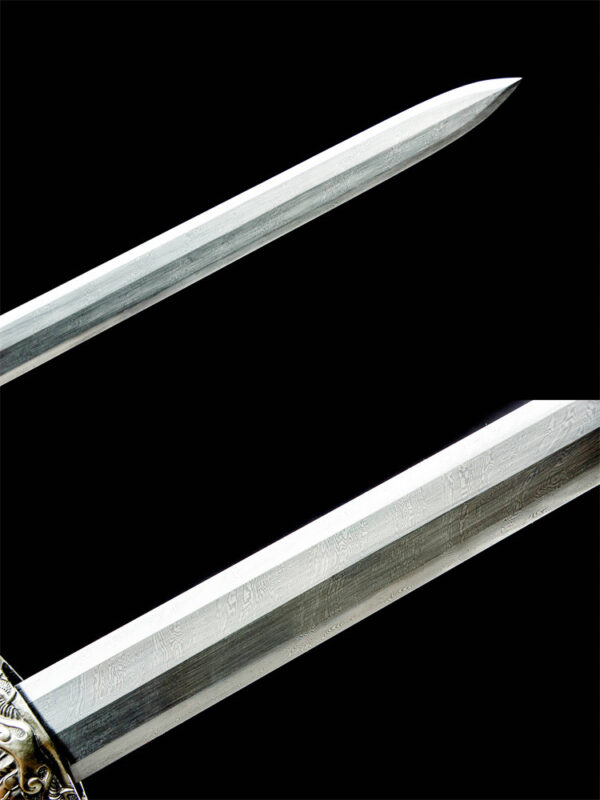
At this time, steel weapons also stepped onto the stage. Perhaps sufficient knowledge had been accumulated in the forging and smelting techniques of bronze weapons, or perhaps the folding steel technology had already inherited the experience of making bronze weapons. In any case, the level of steel weapons during this period was indeed ahead of the world. Famous sword forging masters such as Ou Yezi and Gan Jiang refined a batch of timeless famous swords: Gan Jiang, Mo Xie, Zhanlu, Ju Que, Chun Gou, Long Yuan, Tai A, Gong Bu, Yu Chang, etc. Even if the physical objects do not exist, their great reputation still makes us feel excited; In the “Spring and Autumn Annals of Wu and Yue”, Xue Zhu commented on the pure hooked sword: “The light is as graceful as the bending sun, and the heaviness is as deep as a lotus flower. It originated from a lake, and its writing is like the rows of stars, and its light is like the overflowing pond of water.” In addition, the Tai A sword “has majestic wings like the waves of flowing water,” the Gongbu sword “has writing like the continuous flow of water,” and descriptions such as turtle inscriptions, manli, star arrangement, overflowing water, ice release, high mountains, abysses, water waves, pearl lapels, and flowing springs all refer to the folding patterns on the sword body. When we see the patterns on ancient swords, we can understand that what the ancients said is not empty words.
Late Warring States period
In the late Warring States period, the state of Qin already used a combination of bronze and iron swords, and the shape of the swords also changed. The length was once increased to about 100 centimeters, and the sword body was narrow and long. The surface was carefully ground and had a layer of chromium salt oxide, which showed a black luster and could prevent corrosion and rust. Many long swords unearthed from Qin tombs in Shaanxi were almost new.
Until the end of the 9th century, Italian bronze sword craftsmanship remained at this level
After the steel weapons were officially equipped in the army, their hardness and toughness were significantly better than bronze, and due to the extensive use of cavalry, combined with their tactical needs of charging into battle and immediately engaging in combat, there were higher requirements for the strength of the weapons. Therefore, by the end of the Western Han Dynasty, steel weapons had almost completely replaced bronze and entered a new era. During this period of hundreds of years of alternation, it was also the peak of the development of bronze weapons. Regardless of length, hardness, and toughness, they showed their last brilliant glory on the historical stage.

After cavalry became the main force of the army’s attack, tactical changes and equipment innovations came with it. Due to the extremely fast speed of cavalry charge, the long sword with one handed force can still directly pierce the enemy and inflict heavy damage, but its impact is also strong enough to pull cavalry off their horses and put them in a difficult situation of being attacked. Therefore, the cutting performance of the short cavalry on horseback is obviously particularly important, and the strong and tough iron tools are also quite mature. The long sword gradually replaced the long sword and completely withdrew from the battlefield in the late Han Dynasty. During this period, long swords were often adorned with jade. After a thousand years, long swords had already decayed, but jade sword ornaments were cherished for their exquisite texture and patterns, becoming an indispensable item in jade. We can say that although swords declined on the battlefield, they still maintained their status as kings among the people.
During the Eastern Han Dynasty
The highest level of Chinese swordsmanship, which is well documented in historical records, should be the “Hundred Steelmaking” that emerged during the Eastern Han Dynasty. Hundred refining is the process of repeatedly heating, folding, forging, and forging a hundred times to remove impurities, and finally forging the purest steel. Unfortunately, such technology is too labor-intensive, often taking several years to obtain three to five divine weapons. By the end of the Tang Dynasty, during the ‘An Lushan Rebellion’, society was in chaos, with nine out of ten houses empty, and the technology of steelmaking gradually lost. In the Northern Song Dynasty, the great scientist Shen Kuo mentioned in his book “Dream Pool Essays” that he visited the Cizhou Forge and watched iron smelting, only then did he come to know the so-called “real steel”. He also recorded a precious sword at that time: someone nailed ten large nails into a pillar, swung the sword and cut off all the nails, but the blade was not damaged at all; Bending forcefully, the sword’s body is like a hook, releasing it with a resounding sound, and it is as straight as an arrow string.


During the Ming and Qing dynasties
In the Ming Dynasty, it deteriorated even further. Qi Jiguang pointed out in his book “Practical Records of Military Training: Miscellaneous Collections” that the craftsmen at that time were unwilling to sharpen their knives properly, resulting in “a dull cut and a bald blade, which became stubborn iron
Emperor Qianlong of the Qing Dynasty was a person who placed great emphasis on cultural governance and martial arts. He particularly loved swords and knives. From the 13th to the 22nd year of the Qianlong reign, he spared no effort in manpower and material resources to produce a batch of exquisitely designed swords and knives. Due to the importance attached by “Jin Shang”, the technology of smelting swords and knives was greatly improved at that time. Is patterned steel equivalent to Baisteelmaking? Based on the fact that there have been few sword and sword works or tomb excavations in China since the Tang Dynasty, it is speculated that the technology of making hundred steel may have been lost after the Tang Dynasty. The technique of using patterned steel on Qing Dynasty’s Kouming knives was likely learned from Japan, Southeast Asia, the Middle East, and India. The best patterned steel in the world is not in China, and our ancient sword casting techniques have not been passed down.